Our ProDentim dental supplement review does not establish that the product treats gum disease, prevents cavities or replaces dental care. Probiotics are a legitimate research subject, but ingredient and category evidence is not proof that a specific retail formula works. Compare the ProDentim seller presentation with the clinical boundaries in the NCCIH probiotic evidence and safety review before making a purchase.
This article contains affiliate links. We may earn a commission if you buy through them, at no extra cost to you.
What does this ProDentim dental supplement review find?
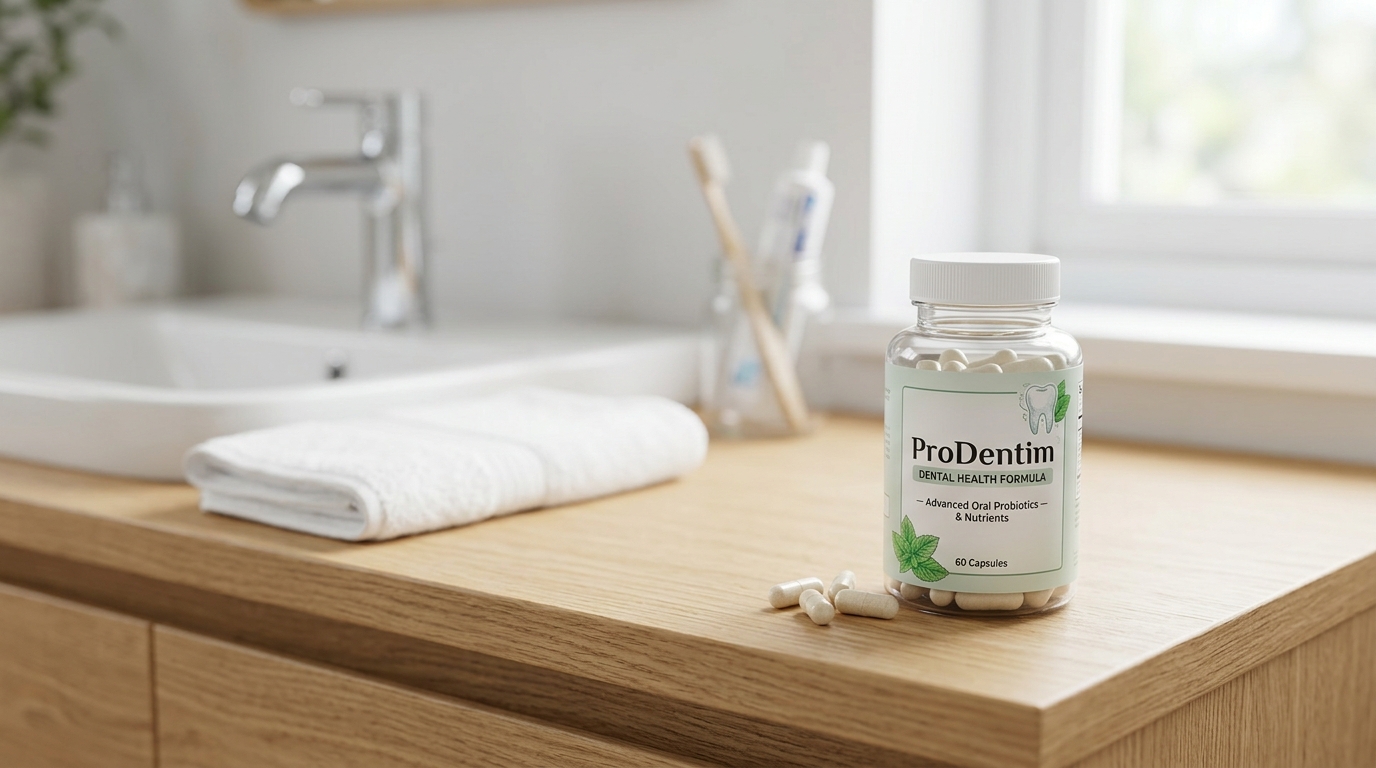
This ProDentim dental supplement review finds an advertised oral-probiotic product but no established finished-product treatment benefit in the sources examined here; the relevant buying question is not whether bacteria can affect oral health; it is whether this identifiable formulation improves a meaningful outcome in appropriate studies without replacing necessary dental care. NCCIH probiotic evidence and safety review
The seller presentation names Lactobacillus paracasei, Lactobacillus reuteri and B. lactis BL-04, alongside other ingredients. That records the commercial description, not an independent confirmation of the contents in a purchased package or a verified match to the intervention used in a clinical paper. ProDentim seller presentation
We have not used ProDentim, tested its microorganisms, audited a manufacturing batch or measured outcomes in customers. Accordingly, this article does not present a typical response time, a satisfaction percentage or a personal before-and-after result; those would require evidence we have not collected.
Does research on oral probiotics prove ProDentim works?
Research on oral probiotics does not automatically prove that ProDentim works because different microorganisms, preparations and treatment contexts can produce different results; a study must be read for the actual intervention and outcome, not borrowed because the seller’s label shares part of a bacterial name with a product that appeared in the literature. NCCIH probiotic evidence and safety review
NCCIH notes that probiotics may have different effects and describes research suggesting they could be a helpful addition to periodontal treatment. It also stresses uncertainty about which preparations help and in what circumstances; that is not a finding that any probiotic product can treat gum disease by itself. NCCIH probiotic evidence and safety review
For a shopper, the useful questions are concrete. Was the actual retail product tested, did participants also receive professional treatment, and did the study measure a clinical outcome rather than only a change in a bacterial count? Without those answers, a mechanism remains a reason for research, not a purchase guarantee.
The same caution applies to cavity claims. Reducing a laboratory measure of bacteria is not automatically proof of fewer cavities in buyers, and this review does not establish a cavity-prevention benefit for the finished ProDentim formula.
What should you examine on the actual product label?
Examine the current label for the complete ingredients, identified microorganisms, serving and storage information before comparing probiotic products; a familiar species name, a larger headline bacterial count or a longer formula is not a clinical ranking; the important question is whether the actual preparation connects to relevant evidence and fits your circumstances. NCCIH probiotic evidence and safety review
The seller also names inulin, malic acid, tricalcium phosphate and peppermint. Their appearance in an advertisement does not establish that the combination whitens teeth, repairs enamel or improves the health of every buyer; each clinical claim still needs evidence about the appropriate intervention and outcome. ProDentim seller presentation
| Detail | What to ask | What it does not establish |
|---|---|---|
| Microorganism names | What precisely is in the product? | Equivalence to every study of that species |
| Headline bacterial count | What does the label say about the serving and viability? | A better dental outcome than another product |
| Added ingredients | What purpose and evidence are claimed? | Enamel repair or whitening from a blend description |
| Testimonials | Are methods and complete outcomes available? | A controlled clinical comparison |
Do not infer a missing ingredient from another review or assume the package sold in every market is identical. Obtain the panel for the product you would buy and resolve discrepancies before placing an order.
What should remain the foundation of oral care?
The foundation of oral care remains appropriate cleaning and dental assessment, not a supplement intended to alter the microbiome; Professional guidance on gum disease includes fluoride toothpaste, cleaning between teeth and routine dental visits; a commercial probiotic claim should not be used to remove those measures or discourage treatment that a dentist has recommended. NIDCR gum-disease guidance
NIDCR recommends brushing twice daily with fluoride toothpaste and regular interdental cleaning. It also explains that only a professional cleaning can remove tartar; a dissolving product or a fresh feeling in the mouth does not establish that hardened deposits have been removed. NIDCR gum-disease guidance
For established periodontal disease, treatment may involve professional cleaning or other care according to its extent. The point of a review is not to replace that decision with a general supplement recommendation or imply that a natural label makes mechanical and professional treatment unnecessary. NIDCR gum-disease guidance
If a product advertisement suggests ordinary dental care is the cause of the problem, compare that statement with independent guidance rather than immediately changing your routine. Ask your dentist about any concern involving a prescribed rinse or your specific cleaning plan.
When should gum symptoms or bad breath be checked?
Persistent bad breath, bleeding or swollen gums, loose or sensitive teeth and pain while chewing deserve dental assessment rather than an assumed probiotic deficiency; Symptoms can point to a problem needing examination, and feeling temporarily fresher does not establish that the cause has resolved or that the supporting tissues around teeth are healthy. NIDCR gum-disease guidance
NIDCR describes gum examination, tooth examination, medical history and sometimes imaging as parts of assessment. Those checks address information a supplement review cannot provide, including the condition of the tissues and supporting bone; a shopping quiz is not an equivalent examination. NIDCR gum-disease guidance
Bring relevant medicines and the product label to the appointment. You can ask whether an optional probiotic has any role after the dental problem is identified, but do not make the appointment conditional on finishing a bottle or reaching a seller’s predicted result window.
Our gut-health guide covers a different area of wellbeing. The fact that a product is probiotic does not make evidence from the gut interchangeable with evidence for teeth and gums, nor does it establish that an oral symptom comes from the digestive tract.
Who needs extra caution before using a probiotic?
People with serious illnesses or compromised immune systems need particular caution before using probiotics, and the decision should be made with the relevant health professional; a claim that organisms are beneficial does not establish safety for every person, especially when the exact product and individual clinical circumstances have not been reviewed. NCCIH probiotic evidence and safety review
NCCIH notes limited detailed safety information and a greater risk of harmful effects in people with severe illness or impaired immunity. Those boundaries matter even when many healthy users tolerate probiotics; a broad reassurance about natural ingredients cannot be extended to everyone. NCCIH probiotic evidence and safety review
Do not introduce the product to a child or a person with complex medical care simply because a sales page uses family-friendly language. Ask the treating professional about the actual preparation, and do not use a supplement as a reason to postpone evaluation of a health problem. NCCIH probiotic evidence and safety review
For general nutrition context, our B-complex supplement buying guide and practical meal guide are separate resources. They do not establish that a nutritional product or dietary change treats an existing dental condition.
How can you make a proportionate buying decision?
Make the purchase decision only after identifying the goal, the evidence gap and whether essential dental care is already addressed; an optional product should have a clear place in the plan, and a discount, testimonial or refund promise should not turn uncertainty about gum symptoms into a commitment to several bottles.
- Have persistent oral symptoms assessed and follow the recommended care plan.
- Obtain the readable current product label and compare it with the offer.
- Ask whether the evidence concerns the finished product or a different probiotic.
- Review suitability, particularly where illness or immune problems are relevant.
- Read the actual checkout, payment and return conditions before deciding.
The practical verdict is cautious rather than dismissive of probiotic research. The category can be studied seriously while a particular retail purchase remains unproven for the outcome you want; those statements are compatible and should not be collapsed into either a guaranteed success or a sweeping rejection. NCCIH probiotic evidence and safety review
What does the ProDentim purchase link establish?
The ProDentim purchase link establishes a commercial route to examine, not that the product improves oral health or belongs in your treatment plan; if you consider the offer, check the current package and checkout conditions; neither a linked advertisement nor a refund policy resolves the clinical evidence questions discussed in this review.
A seller’s marketing presentation can describe the offer but should not decide whether bleeding, persistent bad breath or another oral symptom needs professional attention. Keep those decisions separate, and do not interpret a commercial link as a recommendation to replace established dental care. NIDCR gum-disease guidance
FAQ: what else should you know?
The following questions address common choices that arise when a probiotic is marketed for teeth and gums; Their purpose is to distinguish an optional commercial product from cleaning, assessment and treatment, without promising a response time, assigning a personal regimen or treating all probiotic preparations as clinically interchangeable.
Does ProDentim really work?
This review has not established a treatment benefit for the finished product. Research on a different probiotic or an adjunct to dental treatment cannot automatically validate the retail formula. NCCIH probiotic evidence and safety review
Does ProDentim regrow teeth?
No such benefit is established by the sources examined here. Do not convert an oral-health or microbiome claim into a promise that a supplement regenerates a tooth.
Does ProDentim whiten teeth?
This review does not establish a whitening outcome for the finished product. Listing malic acid in a seller’s presentation is not a verified clinical whitening comparison. ProDentim seller presentation
Is ProDentim safe?
A general natural or probiotic label does not establish safety for every user. People with serious illness or compromised immunity need particular caution and professional advice. NCCIH probiotic evidence and safety review